
Exam Information 2023-204

Examinations can be a challenging time for many young people and their families, therefore it is important that all those involved are as well informed as possible.
At Sacred Heart, we recognise the vital role of parents/carers in the run up to year 11 exams and it is our intention to equip you with the knowledge you need to support your child through this time. Through working together, we hope that your child will be supported in a unified, consistent way, enabling them to fulfil their potential.
For as the body is one and has many members, but all the members of that one body, being many, are one body, so also is Christ.
As part of our examination support we will cover:
- Effective revision strategies
- Guidance on organisation
- Advice on supporting mental health and wellbeing
- Signposting additional sources of support
Effective revision strategies
These strategies centre around the concept of Active Revision:
- EFFECTIVE REVISION INVOLVES THINKING HARD
- RETRIEVAL NOT RE-READING
Effective revision feels challenging. Just like physical training, mental training requires effort. If you wanted to build muscle, you would lift heavy weights. And do so repeatedly and regularly. The same principles apply to building memory.
Many of the revision techniques that students prefer (such as re-reading notes and highlighting), require little mental energy. This is why they feel good. Unfortunately, this also means that they are unlikely to lead to long term memory.
Techniques that are more effective require pupils to recall or retrieve information from their memory without looking it up.
For example:
- Completing past paper questions
- Self – quizzing, using the ‘look, cover, say, write, check’ method
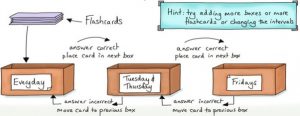
- The flashcard method
- Online tests such as Seneca Learning, Dr Frost, Corbett Maths, Maths genie, Language Nut and GCSE Bitesize
Through using these techniques, that make you think hard, you are more likely to remember what you have learnt in the long term.
Another effective revision technique is called ‘Spaced Practice’. It involves revising little and often and revisiting topics you find difficult more often.
You should aim to keep each revision slot between 30 and 45 minutes with a break in between. The system below is effective at supporting memory and retrieval. Search The Lietner Method with flashcards for more information.
Organising your revision
MAKE A TIMETABLE
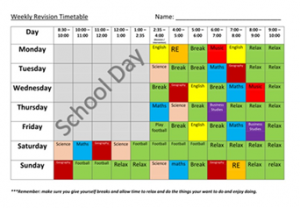
Making and using a revision timetable is an excellent way of ensuring you use your time effectively. We recommend that you complete around 1-2 hours of revision on a school day, and around 4 hours of revision on a non-school day.
Make sure to schedule breaks, extra-curricular activities and time with friends and family.
LITTLE AND OFTEN
Most revision slots should last around 30-45 minutes to ensure that your brain is active and taking-in information. Aim to place the subjects and topics that you find hardest earlier in the day when your brain is more active. To ensure you cover all of the material you need to, be as specific as possible, e.g. “Geography: Coasts”.
SHARE AND USE IT
For a revision timetable to be effective, you need to stick toA good way to do this is to share it with your family. This allows them to help you to achieve your aim. Once you have completed a revision session, tick it off on your timetable. Over time this will form a visual reminder of all of the revision that you have done, helping you to feel a sense of accomplishment and recognise your hard work.
Supporting Mental Health and Wellbeing
 Preparing for exams is often a stressful time for young people (and their families). We are
keen that our pupils understand that worrying about exams is perfectly normal. In fact, a certain amount of stress can improve performance, motivating us to prepare effectively.
However, We all need to develop strategies to help us manage our worries and keep stress levels at an acceptable level and most importantly ask for help when we need it.
The following guidance is taken from the Anna Freud centre who work to support the mental health of young people. The principles are informed by Cognitive Behaviour Therapy (CBT), a therapeutic approach commonly used to treat anxiety. The principles are based on the following strategies:
Creating a safe space for conversation – Demonstrate that you are available to talk but don’t force the conversation at the wrong time as this may feel intrusive. Be open and consistently available, allowing conversation to flow when the young person is ready and willing to talk. Children and young people often find it easier to talk while doing another activity, such as drawing, walking the dog or sitting side by side in the car.
Introducing alternative perspectives – A worry is a thought, not necessarily a fact. Listen to the young person and try to understand exactly what they are concerned about. What exactly are they worried about, and are their worries likely to happen? If so, what would it mean if they did? Exploring alternative ways of looking at things might help to put worries into perspective and in turn result in less anxiety-provoking conclusions.
Demonstrating calm – Try to model a calm and measured response. We know that children are good at noticing when others around them are anxious and will watch the behaviour of others to work out whether they too should feel anxious themselves. Even if you’re feeling anxious on the inside, you can help the young person by remaining calm on the outside. This will help to reassure them that things might be difficult, but they are manageable.
Further sources of help and support
If you are worried about your child please contact school via email of phone (01642 487100) [email protected]
We will direct your enquiries to the right person to support you
